
 WhatsApp

DOING ECO
Environmental Protection Equipment Manufacturer

Environmental Protection Equipment Manufacturer
Palm waste is produced in large quantities across palm-growing regions. Empty fruit bunches (EFB), palm kernel shells (PKS), plam oil sludge, mesocarp fiber, palm fronds, and other residues can quickly pile up after harvesting and processing. For businesses that handle these materials, getting rid of the waste can take time, space, and money. If it is burned or left to decompose without proper treatment, it can also create smoke, odor, and other environmental problems.
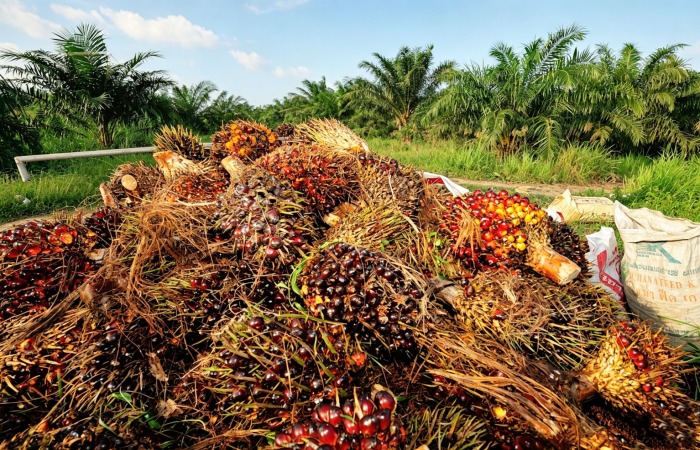 Carbonization of palm waste
But palm waste does not have to end up as waste. With the right equipment, these residues can be processed into charcoal through palm waste charcoal production, giving low-value biomass a more useful application and creating an opportunity to generate additional income.
Why Is Palm Waste Suitable for Charcoal Production?
Palm residues are suitable feedstocks for palm waste carbonization because they contain a good amount of fixed carbon precursors and organic matter that can be converted into solid carbon during pyrolysis. Materials such as palm kernel shells, empty fruit bunches, plam oil sludge, and palm fiber can all be carbonized to produce charcoal, although their moisture content, density, particle size, and fiber structure vary. Proper drying and pretreatment steps such as crushing or briquetting are therefore important to ensure stable carbonization and good charcoal yield.
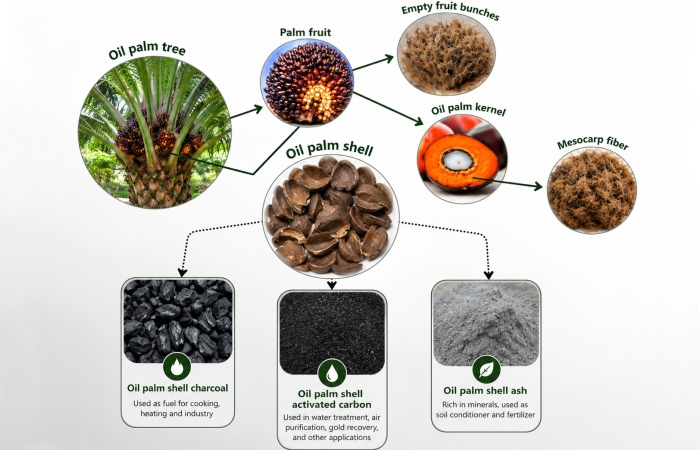 Advantages of Palm Charcoal Production
After proper drying and carbonization, the plam waste biomass loses most of its volatile components and is converted into charcoal with a much higher carbon content than the original raw material. This makes the final product more suitable as a solid fuel and gives palm waste a much higher value than it has in its original form.
For businesses with a stable supply of palm residues, palm waste carbonization can be a practical way to make better use of the material instead of simply storing, dumping, or burning it.
How Can Palm Waste Carbonization Create More Value?
Carbonizing palm waste can turn EFB, palm kernel shells, palm fiber, palm oil sludge, and other residues into a product with real market value. Instead of paying to handle or dispose of these materials, you can use them as raw materials for palm waste charcoal production.
The finished charcoal can be sold as cooking or BBQ charcoal, made into briquettes or charcoal sticks, or used as fuel for heating and industrial applications. Depending on the raw material, quality, and final product, biomass and shell-based charcoal can be worth several hundred to more than US$1,000 per ton in bulk markets, while higher-grade briquettes can command higher prices.
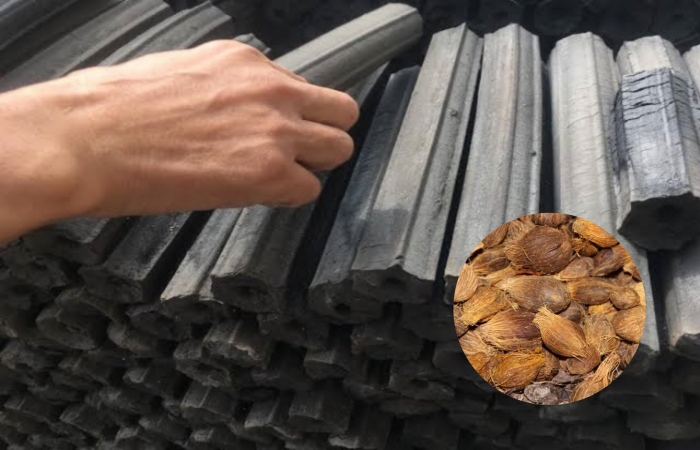 Charcoal production from palm waste
This means palm waste carbonization can give you more than one way to create value — you can sell the charcoal, process it into a higher-value fuel product, or use it yourself to reduce fuel costs.
DOING Charcoal Production Equipment for Palm Waste
Different palm residues have different moisture levels, sizes, and physical structures, so the carbonization system needs to be able to handle these differences. DOING provides palm waste charcoal production equipment for EFB, palm kernel shells, palm fiber, and other biomass materials. Depending on the raw material, required capacity, and final product, the production line can be equipped with different machines such as crushers, dryers, carbonization equipment, cooling systems, and briquette presses.
One of the key features of DOING's palm waste charcoal production equipment is its double-drum structure with hot air heating. The inner drum is mainly used for preheating and removing moisture from the raw material before it enters the main carbonization stage. The outer drum then provides the environment needed for pyrolysis and carbonization. By separating the drying and carbonization stages, the system can better control the moisture entering the pyrolysis zone.
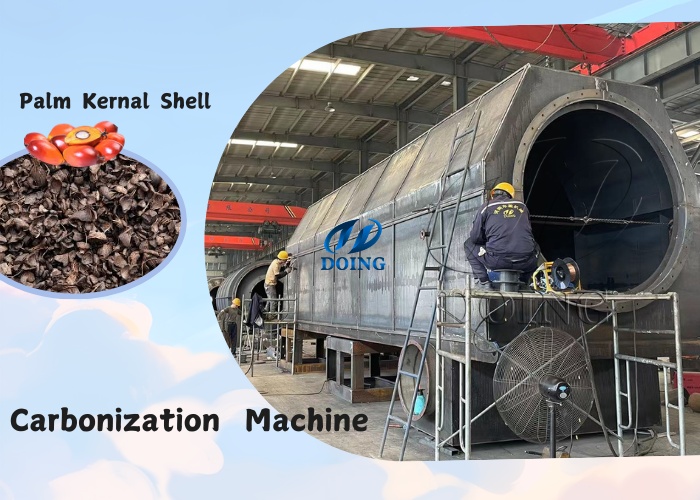 DOING palm waste carbonization machine
This is especially important for palm waste, as materials such as EFB and palm fiber can contain a relatively high amount of moisture. The design also helps reduce the amount of water-gas reaction during carbonization, which means less fixed carbon is lost during the process. With sufficient residence time, the biomass has more time to undergo condensation and carbonization reactions, helping improve the charcoal yield and fixed carbon content.
Another important part of DOING's carbonization system is gas utilization. During carbonization, combustible gas is produced. DOING's system can collect and reuse this gas as a heating source for the carbonization process instead of allowing it to go to waste. This helps reduce the need for external fuel and can lower energy consumption during continuous operation.
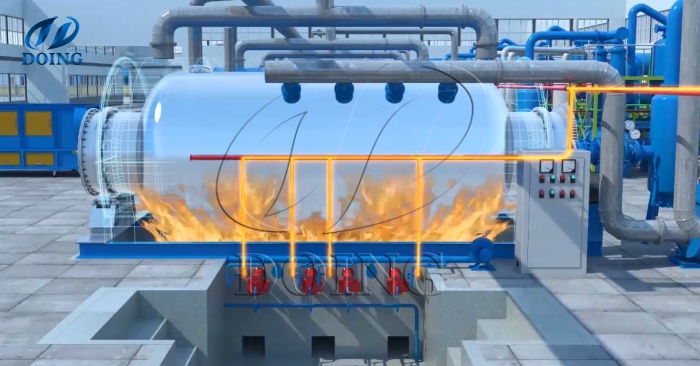 Carbonization off-gas recovery equipment
DOING palm waste charcoal production equipment can also be customized according to the customer's raw materials, processing capacity, and final product requirements. Whether the goal is to produce fuel charcoal, BBQ charcoal, or charcoal briquettes, the configuration can be adjusted accordingly.
DOING has provided carbonization equipment and technical solutions for customers handling palm waste in regions with abundant palm biomass, including Indonesia, Malaysia, Thailand, India, Ghana, Nigeria, Colombia, and other countries. These projects involve different types of palm residues and production requirements, giving our engineering team practical experience in designing and supplying carbonization systems for different raw materials and operating conditions.
Turn Palm Waste Into a Business Opportunity
There is no need to limit palm waste to a single disposal method. If you have access to EFB, palm kernel shells, palm fiber, plam oil sludge, or other palm residues, palm waste charcoal production can be a practical way to give these materials a second life.
The right solution depends on the type and moisture content of your raw materials, how much you need to process, and what you plan to do with the final charcoal. DOING can provide a complete charcoal production solution based on these factors, including equipment selection, production line design, and technical support.
Have palm waste and want to know how much charcoal you can produce from it? Contact DOING to discuss your raw materials, capacity, and palm waste carbonization requirements.
 What's Better for End-of-Life Solar Panels: Mechanical Recycling or Pyrolysis?
How to make charcoal briquettes from agricultural waste?
Why Is It Not Recommended To Mix Different Types Of Lithium Batteries Together For Recycling?
Which countries offer policy support for the solar panel recycling business?
How The EU Battery Regulation Impacts Lithium Battery Recycling Startups?
What is the most environmentally friendly way to dispose of batteries?
What's Better for End-of-Life Solar Panels: Mechanical Recycling or Pyrolysis?
How to make charcoal briquettes from agricultural waste?
Why Is It Not Recommended To Mix Different Types Of Lithium Batteries Together For Recycling?
Which countries offer policy support for the solar panel recycling business?
How The EU Battery Regulation Impacts Lithium Battery Recycling Startups?
What is the most environmentally friendly way to dispose of batteries?