
 WhatsApp

DOING HOLDINGS
Environmental Protection Equipment Manufacturer

Environmental Protection Equipment Manufacturer
For end-of-life solar panels, there is no single recycling method that fits every project. Mechanical recycling and pyrolysis each have different advantages, and the better choice depends on the panel type, processing capacity, desired products, and investment plan.
Mechanical recycling is generally well suited to projects that want a relatively simple physical separation process for recovering glass, aluminum, silicon and metals. Pyrolysis, on the other hand, uses controlled thermal treatment to remove polymer layers such as EVA and is particularly useful when delamination and the recovery of intact glass, silicon wafers and metal components are priorities.
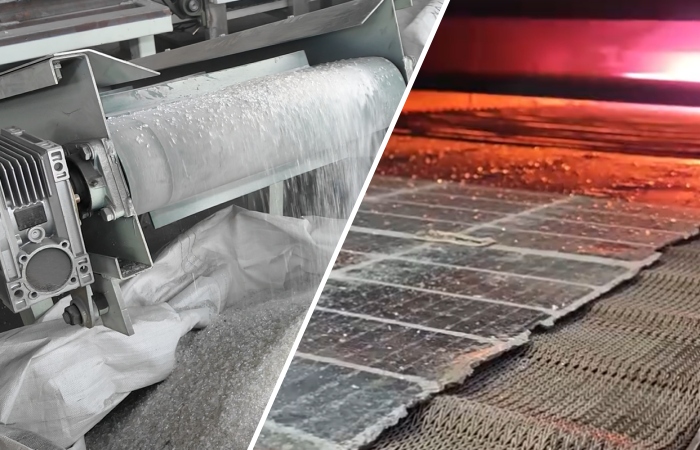 Mechanical recycling vs. pyrolysis
For many conventional PV waste streams, mechanical solar panel recycling provides a practical way to recover valuable materials through a dry physical separation process. For recyclers evaluating a new PV recycling line, the key question is therefore not simply “Which technology is better?”, but “Which technology better matches my panels and business model?”
Mechanical recycling uses a series of physical processes such as dismantling, crushing, screening, gravity separation and electrostatic separation. It does not rely on chemical treatment or high-temperature polymer decomposition.
Pyrolysis uses controlled heating to break down the polymer layers inside a solar panel. The thermal process helps separate the bonded layers of the module and can be used to recover relatively intact components.
| Factor | Mechanical Recycling | Pyrolysis |
| Main principle | Physical crushing and separation | Thermal delamination |
| Typical feedstock | Mainly crystalline-silicon panels, especially single-glass panels | Single-glass and double-glass panels, depending on line design |
| Main outputs | Glass, aluminum, silicon, copper and other metal fractions | Glass, silicon wafers/cells, ribbons and metal components |
| Polymer treatment | Polymers are separated through mechanical processing and become part of fine fractions | EVA and other organic layers are thermally decomposed |
| Energy demand | Generally lower | Higher because of thermal treatment |
| Automation | Semi-automatic to fully automatic | Continuous thermal processing can be highly automated |
| Suitable project focus | Cost-conscious material recovery and higher-volume physical separation | Delamination and recovery of more intact components |
Neither route is universally better. The most appropriate option depends on what the recycler wants to recover and how the line will be operated.
Mechanical recycling is attractive for customers who want a straightforward physical recycling process with a relatively simple plant layout. A typical mechanical line can include aluminum frame and junction-box removal, glass separation, crushing, screening, gravity separation and electrostatic separation. The resulting material streams can include glass, aluminum, copper, silicon and other metal fractions.
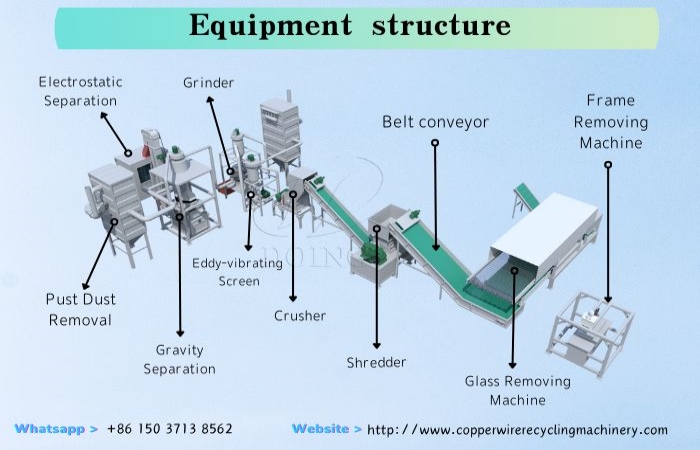 Mechanical solar panel recycling process
This approach is particularly suitable for recyclers handling large quantities of conventional crystalline-silicon PV panels and focusing on bulk material recovery.
Single-Glass Panels
For single-glass panels, mechanical solar panel recycling can be a practical option because the module structure can be processed through multiple physical separation stages after preliminary dismantling. DOING ECO can provide different mechanical configurations according to the customer's capacity and automation requirements:
Semi-automatic lines for customers looking for a simpler and lower-investment solution.
Fully automatic lines for larger projects that prioritize automation and processing efficiency.
Automated mechanical lines can handle more than 700–900 kg/h, while fully automatic configurations can process around 1,000 kg/h, or approximately 55–60 panels per hour, depending on the panel size and feedstock. Both configurations use physical recycling processes without chemical treatment.
What Products Can Be Recovered?
Depending on the equipment configuration and feedstock, mechanical recycling can separate useful fractions such as:
Glass
Aluminum frames
Copper and other metals
Silicon-containing material
Plastic fractions
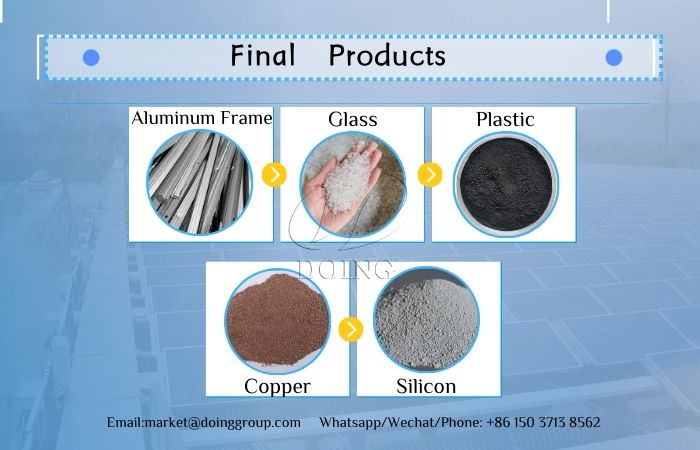 Recovered materials from solar panels
For customers whose main business is recovering and selling these bulk material streams, mechanical recycling can provide a practical production route.
Pyrolysis becomes more attractive when the layered structure of the PV module is the main recycling challenge.
A crystalline-silicon module contains glass, encapsulant, solar cells, backsheet and metal components bonded together. Solar panel pyrolysis uses controlled heat to break down the organic encapsulant, helping separate these layers. This makes a pyrolysis line particularly interesting for customers who want to process both single-glass and double-glass modules and place greater emphasis on recovering relatively intact glass, silicon wafers and ribbons.
Double-Glass Panels
Double-glass modules can present different recycling requirements from conventional backsheet-based panels because glass is used on both sides of the module. For projects with a significant amount of double-glass PV waste, a thermal delamination route can therefore be considered alongside mechanical options.
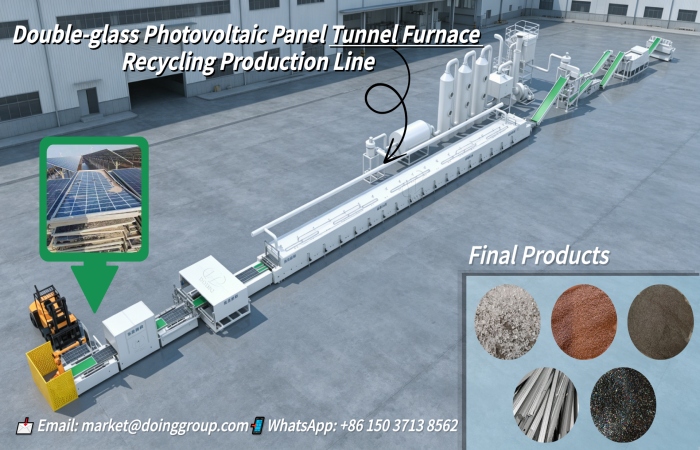 Double-glass PV panel pyrolysis
DOING ECO's tunnel furnace line is designed for this type of application. It can process single-glass and double-glass PV panels through thermal treatment and separate the module into useful material streams. For large-scale projects, solar panel pyrolysis can provide a continuous thermal treatment route for end-of-life PV modules.
The typical recovered products include:
Silicon wafers
Whole glass
Metal ribbons
Other recyclable components
This makes the tunnel furnace particularly relevant to customers who place more value on component separation rather than simply reducing the panels into mixed material fractions.
The choice mainly comes down to your feedstock, annual processing volume and target products.
If you mainly have single-glass monocrystalline or other crystalline-silicon panels and want to recover glass, aluminum, silicon and metal fractions through a physical process, a mechanical recycling line may be a suitable choice. DOING ECO's mechanical solutions can handle more than 700–900 kg/h for automated lines and around 1,000 kg/h for fully automatic lines (about 55–60 panels per hour). This makes mechanical recycling suitable for small to large-scale PV recycling projects, depending on the selected configuration and operating schedule.
For projects with an annual processing volume of more than 10,000 tons, especially those handling a significant amount of double-glass panels or focusing on recovering relatively intact glass, silicon wafers and ribbons through thermal delamination, a continuous pyrolysis tunnel furnace can be considered.
In short, mechanical recycling is a practical option for physical material separation and flexible processing capacity, while pyrolysis is particularly suitable for large-scale projects where thermal delamination and component recovery are the priority.
DOING ECO provides both mechanical solar panel recycling lines and pyrolysis tunnel furnace solutions, allowing the recycling process to be selected according to the customer's actual feedstock and production requirements.
For mechanical recycling projects, DOING ECO can provide semi-automatic and fully automatic solutions for different investment and capacity requirements. For projects handling single-glass and double-glass modules or requiring thermal delamination, the tunnel furnace solution provides another option.
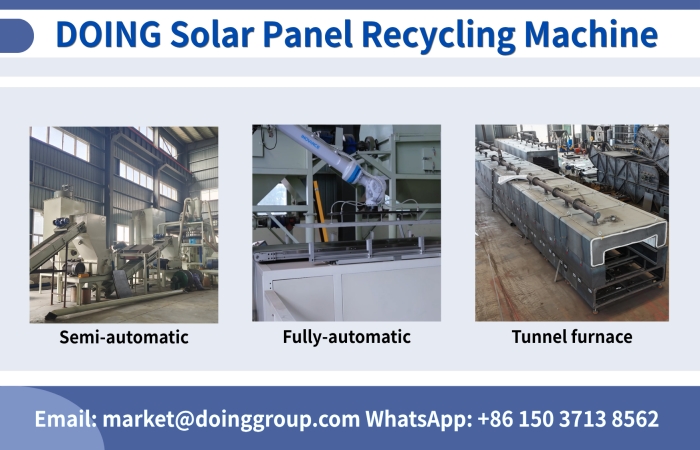 Three PV recycling line options
For customers looking for an end-of-life solar panel recycling machine, DOING ECO can recommend either a mechanical recycling line or a pyrolysis tunnel furnace according to the panel type, processing capacity and target products.
The equipment can be customized around key project parameters such as:
Solar panel type and structure
Single-glass or double-glass modules
Monocrystalline silicon PV panels
Required processing capacity
Desired recovered products
Automation level
Available space and project conditions
This makes it easier to select an end-of-life solar panel recycling machine that matches the actual feedstock and production requirements.
If you are not sure whether mechanical recycling or pyrolysis is more suitable for your end-of-life solar panels, send DOING ECO your panel type, daily/monthly feedstock and required capacity. Our team can recommend a suitable recycling configuration and provide a project-specific solution.
 What's Better for End-of-Life Solar Panels: Mechanical Recycling or Pyrolysis?
How to make charcoal briquettes from agricultural waste?
Why Is It Not Recommended To Mix Different Types Of Lithium Batteries Together For Recycling?
Which countries offer policy support for the solar panel recycling business?
How The EU Battery Regulation Impacts Lithium Battery Recycling Startups?
What is the most environmentally friendly way to dispose of batteries?
What's Better for End-of-Life Solar Panels: Mechanical Recycling or Pyrolysis?
How to make charcoal briquettes from agricultural waste?
Why Is It Not Recommended To Mix Different Types Of Lithium Batteries Together For Recycling?
Which countries offer policy support for the solar panel recycling business?
How The EU Battery Regulation Impacts Lithium Battery Recycling Startups?
What is the most environmentally friendly way to dispose of batteries?