

 WhatsApp

DOING ECO
Environmental Protection Equipment Manufacturer

Environmental Protection Equipment Manufacturer
The biggest fire risks in the lithium battery recycling process come from residual energy in the cells, internal short circuits created when cutting or crushing punctures a battery, and combustible black mass dust generated during shredding. Official policies like EPA guidance also note that batteries are commonly discharged before shredding or otherwise managed to prevent fires during processing.
DOING ECO controls these hazards by running the shredder in a nitrogen-blanketed chamber, classifying batteries before they enter the line, and linking PLC monitoring to automatic nitrogen injection and pressure relief. Storage segregation and inspection handle the rest. Check the detailed risk control solutions here;
The main lithium battery storage risks come from remaining electrical energy, damaged cells and poor storage conditions. A battery that is swollen, damaged or defective can become a fire hazard, while short circuits may occur when battery terminals contact conductive materials. Excessive heat can also increase the risk of battery failure.
 Fire risks during lithium battery storage
For recycling facilities, storage management should therefore include separating damaged lithium batteries from normal batteries, preventing physical damage, maintaining suitable ventilation and keeping battery storage away from unnecessary combustible materials. EPA also recommends advanced fire detection and suppression, as well as regular visual and thermal inspections for end-of-life lithium batteries.
Lithium battery shredding introduces additional mechanical risks. Cutting, crushing or puncturing a battery can create internal short circuits and rapidly generate heat. When one cell enters thermal runaway, the heat and gases released can affect nearby cells and potentially lead to fire.
Shredding can also release electrolyte residues and fine battery dust. EPA research has documented that lithium-ion batteries passing through shredders can be punctured and ignite, which is why battery condition and pre-processing are important parts of lithium battery recycling safety.
 Fire risks during lithium battery shredding
That means you should not evaluate a recycling line by throughput alone. Chemistry, cell format, incoming condition, chamber atmosphere and the dust-control system all determine whether the process stays stable.
Before lithium battery shredding, batteries should be identified and classified according to their condition and chemistry. Damaged, defective or swollen batteries require separate handling, while normal batteries can enter the planned recycling process after the required pretreatment.
The conventional approach is to discharge batteries before shredding. DOING ECO's lithium battery recycling process includes battery pretreatment such as discharge and disassembly, followed by crushing and multi-stage physical separation.
However, process design can also vary according to battery chemistry. In a specifically configured low-oxygen shredding system, charged shredding can be used for lithium iron phosphate (LFP) batteries. This approach is not applicable to ternary lithium batteries (NCM), which still require de-energizing before shredding.
For lithium battery recycling, fire-risk control needs to address the main hazards identified during storage and shredding, including residual electrical energy, short circuits, thermal runaway, heat generation and combustible battery dust. DOING ECO (Henan DOING) applies a multi-layer safety approach combining low-oxygen control, enclosed processing, real-time monitoring and automatic emergency response.
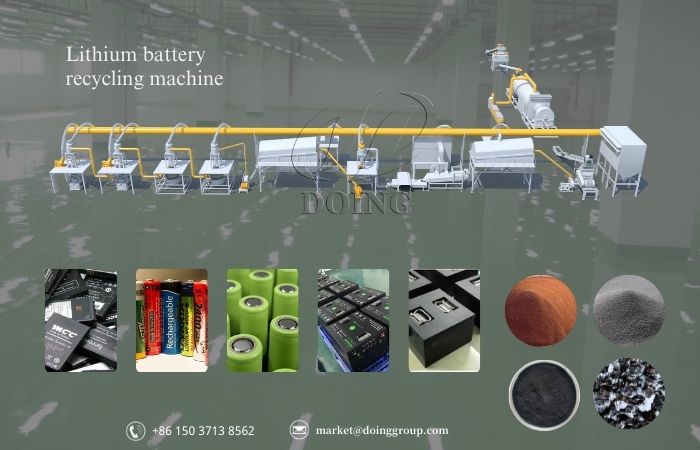 DOING ECO lithium battery recycling machine
A sealed chamber is inerted with nitrogen to keep oxygen below the combustion threshold. Our configured system holds the chamber O₂ concentration at ≤2%, and multi-layer sealing limits oxygen intrusion during operation.
On a controlled low-oxygen line, LFP packs can be shredded without a separate high-risk discharge step. NMC/NCA chemistry still requires discharge or SOC reduction before shredding. We set the route based on your incoming material, not on a single default.
The DOING ECO lithium battery recycling machine uses a PLC automatic control system to monitor and coordinate key operating conditions throughout the recycling process. It integrates equipment operation and safety controls, helping maintain stable processing and providing automatic responses when abnormal conditions are detected.
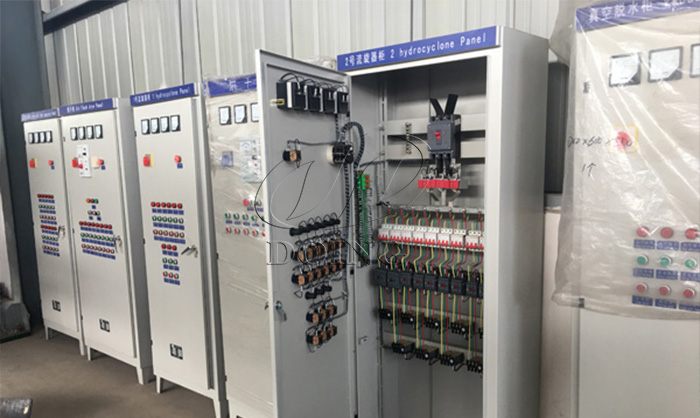 PLC automatic control system for lithium battery recycling
When an abnormal condition is detected, the system can automatically stop feeding, increase nitrogen injection, and activate the pressure-relief and fire-suppression systems. This reduces dependence on manual intervention and allows the equipment to respond rapidly to abnormal operating conditions.
Battery shredding can generate black mass, making dust management an important part of recycling safety. DOING ECO uses an enclosed processing chamber and multi-stage dust collection system to control dust accumulation and support cleaner operation.
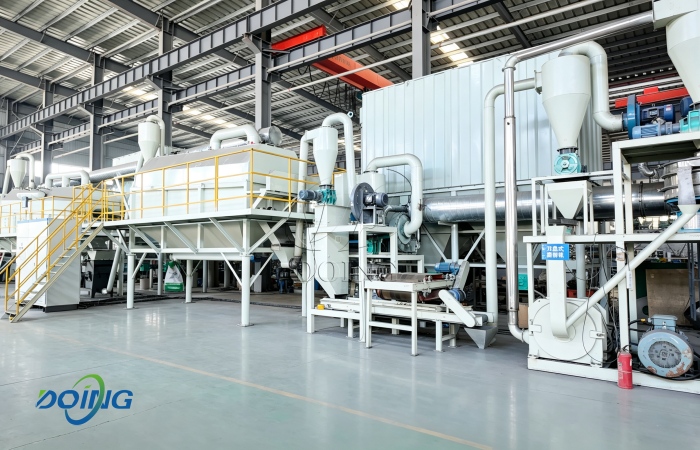 Enclosed processing lithium battery recycling system
Together, these measures address different stages of fire-risk control—from limiting oxygen and controlling mechanical processing to monitoring abnormal conditions and responding automatically. The specific configuration should be determined according to battery chemistry, battery condition and project processing requirements.
Lithium battery fire risks cannot be addressed by shredding equipment alone. Safe battery recycling requires proper storage, battery classification, pretreatment and process control, supported by equipment with appropriate low-oxygen, monitoring, emergency interlocking and dust-control measures.
For projects involving lithium battery recycling equipment, the appropriate configuration should be determined by battery chemistry, battery condition, processing capacity and the required recycling process.
Planning a lithium battery recycling project? Contact DOING ECO to discuss your battery type, material condition, processing capacity and required recycling process, and develop a suitable lithium battery recycling equipment configuration.
They should generally be separated. EPA recommends storing damaged, defective or recalled batteries separately from normal end-of-life batteries and using appropriate handling procedures to reduce the chance of thermal runaway.
Not necessarily. Battery chemistry can affect process parameters and separation performance. DOING ECO's equipment can be configured for different lithium battery types, but process parameters may need to be adjusted rather than using one fixed setting for all chemistries.
Not for all battery types. DOING ECO's charged-shredding configuration is intended for LFP batteries under controlled low-oxygen conditions. NCM batteries require de-energizing before shredding.
No. Equipment-based protection is only one part of lithium battery recycling safety. Storage segregation, battery inspection, ventilation, emergency procedures and worker training remain important risk-control measures.
No equipment can make lithium battery recycling completely risk-free. The purpose of a multi-layer safety design is to reduce ignition opportunities, detect abnormal conditions early and limit the consequences of an incident through coordinated process and emergency controls.
 What's Better for End-of-Life Solar Panels: Mechanical Recycling or Pyrolysis?
How to make charcoal briquettes from agricultural waste?
Why Is It Not Recommended To Mix Different Types Of Lithium Batteries Together For Recycling?
Which countries offer policy support for the solar panel recycling business?
How The EU Battery Regulation Impacts Lithium Battery Recycling Startups?
What is the most environmentally friendly way to dispose of batteries?
What's Better for End-of-Life Solar Panels: Mechanical Recycling or Pyrolysis?
How to make charcoal briquettes from agricultural waste?
Why Is It Not Recommended To Mix Different Types Of Lithium Batteries Together For Recycling?
Which countries offer policy support for the solar panel recycling business?
How The EU Battery Regulation Impacts Lithium Battery Recycling Startups?
What is the most environmentally friendly way to dispose of batteries?