
 WhatsApp

DOING ECO
Environmental Protection Equipment Manufacturer

Environmental Protection Equipment Manufacturer
Before diving into technical details, it is essential to understand the core commercial and operational differences between these two waste solar panel recycling routes to determine which best fits your business model:
Processing Results: Mechanical solar panel recycling typically yields fragmented outputs like glass granules, silicon powder, and mixed metal fractions. In contrast, thermal solar panel recycling uses heat to decompose encapsulants, often preserving larger, more intact material pieces that can be easier to sell to downstream smelters or glass manufacturers.
Market Value & Commercial Aspects: Because thermal treatment can produce cleaner, higher-purity separated materials, the recovered fractions often command better market prices. Mechanical outputs, while valuable, may require additional downstream refining to achieve similar purity levels.
Cost, Efficiency & Economics: Mechanical solar panel recycling equipment generally involves lower CAPEX and OPEX, offering higher throughput for standard modules. Thermal recycling requires specialized pyrolysis furnaces, resulting in higher initial investment and energy costs, but it is often the only economically viable route for complex double-glass solar panels.
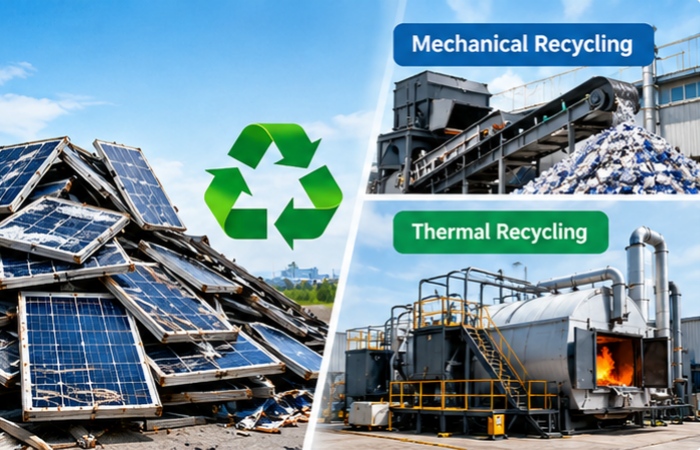 Mechanical and thermal recycling of solar panels
Neither process is universally better. The key difference between mechanical solar panel recycling and thermal solar panel recycling is how the materials are separated.
Mechanical recycling uses physical methods such as dismantling, crushing, grinding, screening and sorting to separate materials. Thermal recycling uses controlled heating to break down the encapsulant and other organic layers before further separation. This difference affects the form of the recovered materials, the panel types that can be processed and the type of solar panel recycling equipment required.
Mechanical solar panel recycling is primarily a physical process where the panel is first dismantled to remove the aluminum frame and junction box. Depending on the specific solar panel recycling process, controlled low-temperature heating may also be applied to soften the EVA layer before glass removal. The remaining material is then processed through cutting, crushing, grinding, screening, and separation steps, utilizing air, magnetic, and electrostatic separators to isolate different material fractions.
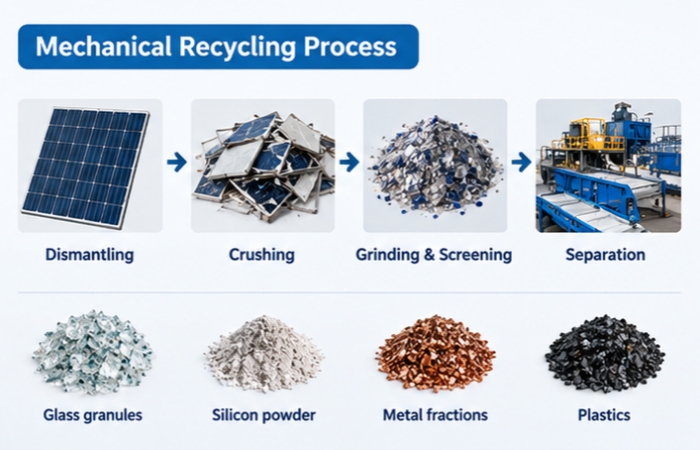 Mechanical solar panel recycling process
The typical output consists of fragmented materials such as glass granules, silicon-containing powder, copper and aluminum fractions, and plastics rather than large intact components. The main advantage of this mechanical PV panel recycling route is its straightforward physical separation, making it highly suitable for single-glass solar panels when the project focuses on practical processing rather than preserving larger material pieces.
Thermal recycling, also known as pyrolysis, uses controlled heating to remove the bonding organic materials inside the solar module. After preliminary dismantling, the panel is treated in a thermal system where heat causes materials like EVA to decompose, making subsequent separation of the remaining glass, silicon, and metal components significantly easier.
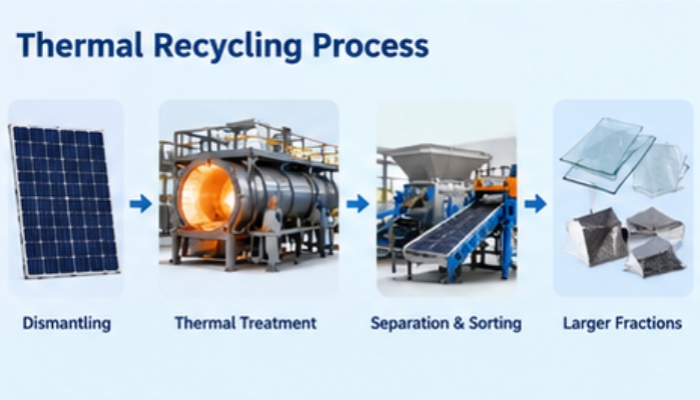 Solar panel pyrolysis recycling process
Unlike mechanical recycling, which mainly breaks the panel into smaller particles, thermal treatment can help preserve larger or more intact material fractions after the encapsulant has been removed. For double-glass solar panels, thermal treatment can be seamlessly combined with downstream sorting because the panel structure differs fundamentally from a conventional single-glass module.
| Key Point | Mechanical Recycling | Thermal Recycling |
| Core principle | Physical dismantling, crushing and sorting | Heat treatment to decompose bonding organic layers |
| Main separation method | Mechanical and physical separation | Thermal treatment + subsequent sorting |
| Material form | More fragmented, often granules or powder | Larger or more intact material fractions can be preserved |
| Typical application | Single-glass panels | Double-glass panels and panels requiring thermal separation |
| Main equipment | Crusher, screening and sorting equipment | Thermal/pyrolysis furnace + sorting equipment |
| Key consideration | Feedstock structure and required material separation | Panel structure, thermal treatment requirements and downstream sorting |
The practical difference is therefore clear:
Mechanical recycling breaks materials apart mechanically. Thermal recycling first uses heat to release bonded layers, then separates the remaining materials.
The choice should be based on the actual feedstock and project requirements.
Choose mechanical recycling when:
The feedstock is mainly single-glass solar panels.
Physical material separation is the main objective.
A fragmented output form is acceptable.
You prefer a mechanical solar panel recycling process without a thermal pyrolysis stage.
Consider thermal recycling when:
The feedstock contains a significant proportion of double-glass panels.
Removing encapsulant through heat treatment is important for the process.
Larger or more intact recovered material fractions are part of the target.
The project is designed around a thermal treatment and subsequent sorting process.
Another important point is that recovery rate and product purity are not the same indicator. The actual performance of a PV panel recycling line depends on the panel type, material composition, equipment configuration and operating conditions.
DOING ECO (Henan DOING) provides both mechanical and thermal approaches for waste solar panel recycling.
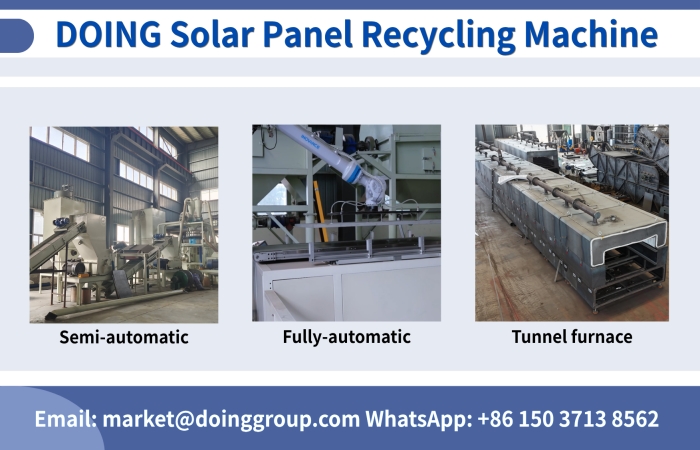 DOING solar panel recycling solutions
For single-glass solar panels, DOING ECO provides semi-automatic and fully automatic mechanical recycling solutions. Its fully automatic solar panel recycling equipment uses crushing and multi-stage physical separation, with a capacity of 1,000–2,000 kg/h.
For double-glass solar panels, DOING ECO provides a tunnel furnace pyrolysis + sorting process. The operating temperature of the solar panel pyrolysis tunnel furnace is 500–550°C.
This two-route approach allows the recycling process to be matched to the actual structure of the waste solar panels instead of forcing different panel types into the same treatment method.
The core difference between mechanical and thermal recycling is physical separation versus heat-assisted separation.
Mechanical solar panel recycling mainly uses dismantling, crushing and sorting to produce separated material fractions. Thermal solar panel recycling uses controlled heating to decompose bonding organic layers before downstream separation.
For single-glass panels, mechanical recycling is a practical route for physical material separation. For double-glass panels, thermal treatment can be a suitable route where heat-assisted separation is required.
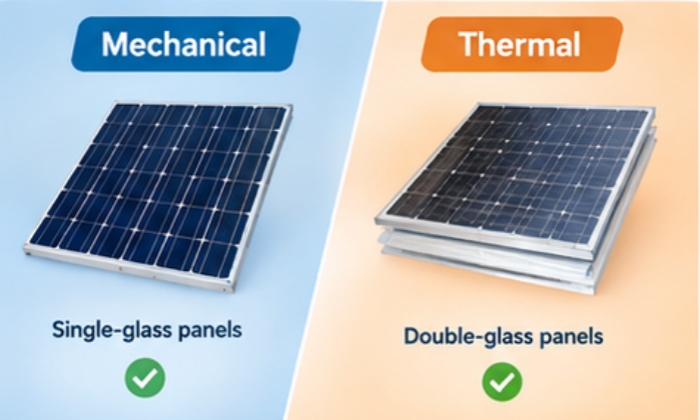 Single-glass and double-glass solar panel recycling method
The right solar panel recycling machine should therefore be selected according to panel structure, processing capacity and target recovered materials—not simply by asking which technology is better.
Yes. Different generations of PV panels use varying material compositions and metal configurations, which directly impact the resulting material fractions and the specific processing requirements of the solar panel recycling machine.
The processing route depends heavily on the panel structure. Since single-glass and double-glass solar panels require different separation approaches, the equipment configuration must be determined based on the actual feedstock mix.
Common sources for waste solar panel recycling include decommissioned solar power plants, production defects and scrap from manufacturers, and materials supplied by intermediaries.
Yes. Depending on the project scale, individual modules such as a glass removal machine or other separation equipment can be purchased instead of a complete recycling line.
Start by assessing the panel structure, expected processing volume, and target recovered materials. These factors provide the foundation for selecting the most appropriate solar panel recycling process and equipment configuration.
 Are There Alternatives to Pyrolysis for Recycling Waste Lithium Batteries?
What's Better for End-of-Life Solar Panels: Mechanical Recycling or Pyrolysis?
How to make charcoal briquettes from agricultural waste?
Why Is It Not Recommended To Mix Different Types Of Lithium Batteries Together For Recycling?
Which countries offer policy support for the solar panel recycling business?
How The EU Battery Regulation Impacts Lithium Battery Recycling Startups?
Are There Alternatives to Pyrolysis for Recycling Waste Lithium Batteries?
What's Better for End-of-Life Solar Panels: Mechanical Recycling or Pyrolysis?
How to make charcoal briquettes from agricultural waste?
Why Is It Not Recommended To Mix Different Types Of Lithium Batteries Together For Recycling?
Which countries offer policy support for the solar panel recycling business?
How The EU Battery Regulation Impacts Lithium Battery Recycling Startups?