
 WhatsApp

DOING HOLDINGS
Environmental Protection Equipment Manufacturer
Environmental Protection Equipment Manufacturer
With the global transition to a circular economy, the full implementation of the EU Batteries and Waste Batteries Regulation (EU Battery Regulation) has established clear rules for the waste battery processing industry. For lithium battery recycling startups, this implies not only a higher compliance threshold but also immense market opportunities.
The EU Battery Regulation sets clear and progressively increasing targets for the recovery rates of critical metals: the recovery rate for lithium must reach 50% by 2027 and rise to 80% by 2031; for cobalt, copper, and nickel, the recovery rate must reach 90% by 2027 and 95% by 2031.
For lithium battery recycling startups, traditional, crude dismantling methods can no longer meet the stringent, detailed requirements of regulations. Enterprises must rely on high-efficiency lithium battery recycling machine to ensure a high recovery rate of "black mass" (containing lithium, cobalt, nickel, etc.) and high-value metals such as copper and aluminum during the processing of spent batteries, thereby meeting stringent material recovery standards.
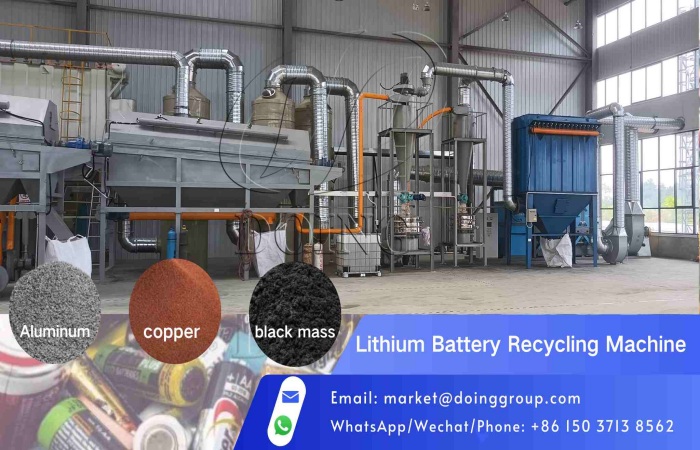 High-efficiency lithium battery recycling machine
The EU Battery Regulation requires a carbon footprint declaration for all types of batteries placed on the European market; this mandate implicitly requires that the recycling process also be low-carbon and environmentally friendly.
If a startup generates significant secondary pollution or consumes high levels of energy during the waste battery processing stage, the recycled materials it produces will struggle to enter the supply chains of mainstream battery manufacturers. Therefore, adopting eco-friendly treatment processes that are low-energy and free from secondary pollution has become key for lithium battery recycling companies looking to expand into global markets.
The EU Battery Regulation explicitly mandates that new batteries contain a certain proportion of recycled materials. This requirement directly boosts market demand for high-quality recycled metals. For lithium battery recycling startups, the ability to consistently produce recycled materials that meet high standards translates into broad and stable business prospects.
In the face of the European Union's stringent battery regulations, the key for lithium battery recycling startups to achieve steady growth in a fiercely competitive market lies in establishing compliant and efficient production lines for processing spent batteries. As a professional manufacturer of lithium battery recycling plant, Doing Company offers startups a physical separation solution that meets modern environmental protection and circular economy standards.
DOING's lithium battery recycling plant utilizes dry mechanical crushing and air separation processes, offering enterprises the following significant advantages:
High-Efficiency Separation for Enhanced Recovery Purity: Through multi-stage crushing, precision screening, and density-based separation, the equipment effectively separates cathode and anode materials (black mass), copper, aluminum, and diaphragm from waste lithium batteries. This superior ≥95% separation purity enables startups to easily meet the specific metal recovery rate targets mandated by EU battery regulation.
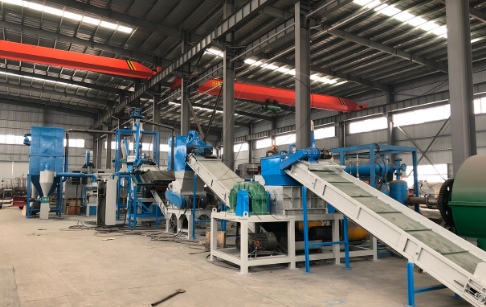
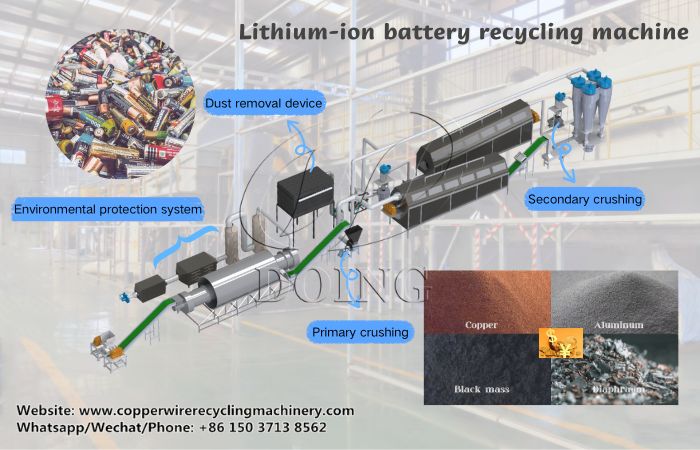 DOING lithium battery recycling plant
Low-Carbon, Eco-Friendly Physical Dry Processing: Unlike traditional methods, this spent lithium battery processing system employs a purely physical dry process that requires no chemical reagents and generates no wastewater. Furthermore, the entire system is equipped with comprehensive pulse dust collection and exhaust gas purification units to effectively control dust and odor emissions, fully aligning with EU regulations regarding carbon footprint and environmental friendliness.
The implementation of the EU Battery Regulation is accelerating the global lithium-ion battery recycling industry's shift toward standardization and environmental sustainability. For startups in this sector, establishing specialized, eco-friendly, and efficient production lines for processing spent batteries at an early stage is a crucial step toward building long-term competitiveness.
If you are preparing a lithium battery recycling project or planning to purchase high-standard lithium battery recycling plant, please feel free to contact us at Doing Company for a consultation.
 What's Better for End-of-Life Solar Panels: Mechanical Recycling or Pyrolysis?
How to make charcoal briquettes from agricultural waste?
Why Is It Not Recommended To Mix Different Types Of Lithium Batteries Together For Recycling?
Which countries offer policy support for the solar panel recycling business?
How The EU Battery Regulation Impacts Lithium Battery Recycling Startups?
What is the most environmentally friendly way to dispose of batteries?
What's Better for End-of-Life Solar Panels: Mechanical Recycling or Pyrolysis?
How to make charcoal briquettes from agricultural waste?
Why Is It Not Recommended To Mix Different Types Of Lithium Batteries Together For Recycling?
Which countries offer policy support for the solar panel recycling business?
How The EU Battery Regulation Impacts Lithium Battery Recycling Startups?
What is the most environmentally friendly way to dispose of batteries?