WhatsApp

DOING ECO
Environmental Protection Equipment Manufacturer
Environmental Protection Equipment Manufacturer
If you are planning to build a lithium battery recycling plant, choosing the right manufacturer is about more than comparing machine prices. A complete recycling line needs to match the battery types, processing capacity, separation requirements, and expected output materials.
For many recyclers, the practical goal is to recover valuable materials such as copper, aluminum, black mass, iron, and plastics through a stable physical separation process. A suitable lithium battery recycling production line supplier should therefore provide not just individual machines, but a complete and properly matched system. So, what should you look for when shortlisting a supplier?
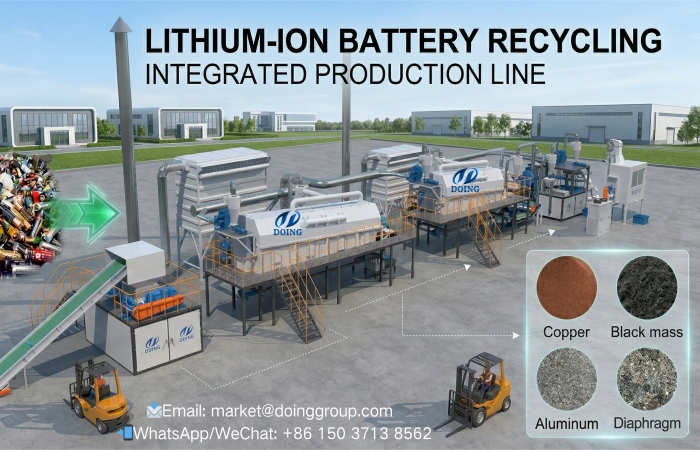 Lithium battery recycling and material recovery
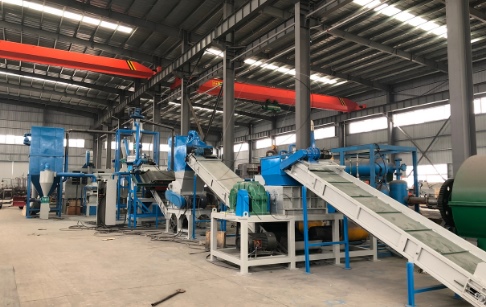
A complete line normally combines several stages rather than relying on one recycling machine. Depending on the feedstock and required output, the process can include feeding, shredding or crushing, magnetic separation, screening, gravity or other physical separation, dust collection, and material conveying.
This type of mechanical pretreatment is used to separate different battery components according to properties such as particle size, density, and magnetic response. The crushing process yields black mass, copper, aluminum, and plastic.
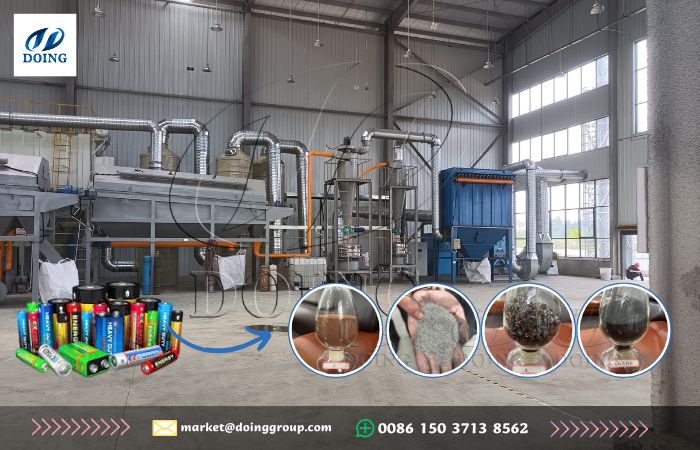 Complete lithium battery recycling line
For a lithium battery recycling line, the key is how these machines work together. A poorly matched crusher, screen, or separator can affect both material recovery and final product quality.
Before contacting a lithium battery recycling production line supplier, it is useful to define:
Battery types: cylindrical, pouch, prismatic, power batteries, or consumer batteries
Feedstock condition and size
Required capacity, such as 500 kg/h or 3,000 kg/h
Target output materials
Required separation efficiency and purity
Available workshop space and operating conditions
These details give manufacturers enough information to configure suitable lithium battery recycling equipment rather than simply recommending a standard machine.
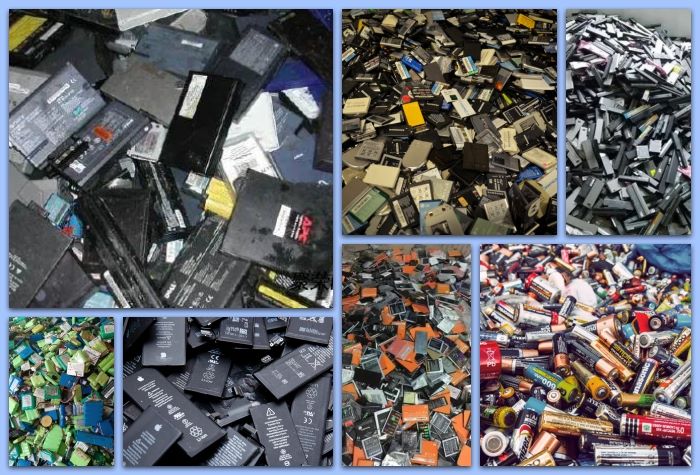 Waste lithium batteries for recycling
DOING ECO focuses on dry physical recycling rather than chemical treatment. Its lithium battery recycling equipment uses mechanical crushing and physical separation to recover different material fractions.
A typical DOING ECO process can include:
Battery feeding → shredding/crushing → magnetic separation → screening → gravity/physical separation → dust collection → output collection
The line can process different types of spent lithium batteries, including phone batteries, plastic-shell batteries, soft-pack batteries, cylindrical batteries, and power batteries, depending on the project configuration.
The main recovered materials include:
Black powder / black mass
Copper
Aluminum
Iron
Plastic
One important point is that incoming batteries need to be discharged before entering the recycling production line. Battery discharge is a necessary preparation step. This is also consistent with common battery recycling practice, where batteries are discharged or otherwise managed to reduce fire risks before shredding.
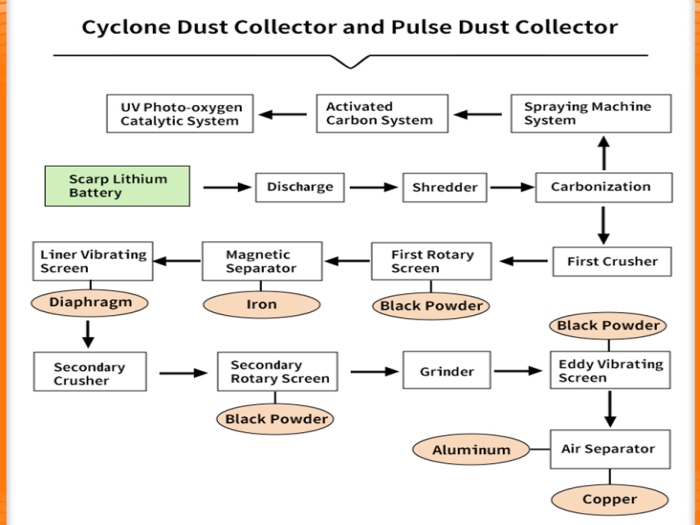 Lithium battery recycling process flow
The equipment is designed for a capacity range of approximately 500–3,000 kg/h, with the final configuration determined by the customer's battery type and processing requirements. DOING ECO's stated target performance is ≥99% recovery rate and ≥98% purity under suitable feedstock and operating conditions.
The system is also designed around physical separation rather than chemical extraction. This makes it important to distinguish between a lithium battery recycling machine manufacturer that supplies mechanical separation equipment and a company providing a different type of chemical or metallurgical recycling process.
Instead of comparing suppliers only by equipment price, look at whether their proposed system fits your actual recycling project.
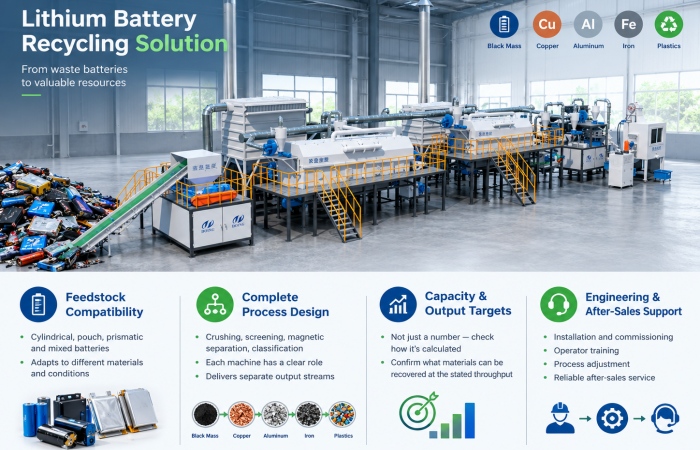 Key factors for selecting a recycling line supplier
Feedstock compatibility
Ask whether the manufacturer has experience with your specific battery formats and feedstock. Cylindrical, pouch, prismatic, and mixed battery waste can behave differently during crushing and separation.
Complete process design
Check whether the supplier can provide the complete process flow rather than only a shredder or crusher. The separation stages after crushing are equally important because black mass, copper, aluminum, iron, and plastics need to be directed into different output streams. A reliable lithium battery recycling machine manufacturer should be able to explain why each major machine is included and how the equipment works together as a complete line.
Capacity and output targets
A stated capacity alone does not tell you whether the line will meet your business goals. Ask how the capacity is calculated and what output materials can be recovered at that throughput.
Mechanical recycling commonly uses crushing, screening, magnetic separation, and classification to separate battery components. Actual separation performance depends on the feedstock and process configuration.
Engineering and after-sales support
A complete recycling project also involves installation, commissioning, operator training, process adjustment, and after-sales service. A lithium battery recycling machine manufacturer that can support these stages can make the transition from equipment purchase to actual operation much more straightforward.
For this reason, a useful shortlist should include manufacturers that can discuss your battery type, capacity, desired outputs, and complete process flow before giving you a final equipment configuration.
DOING ECO can be considered when your project needs a dry mechanical lithium battery recycling line for recovering copper, aluminum, iron, plastic, and black mass. Its lithium battery recycling equipment is suitable for projects requiring approximately 500–3,000 kg/h processing capacity, with the line configured according to the incoming battery materials and desired separation results.
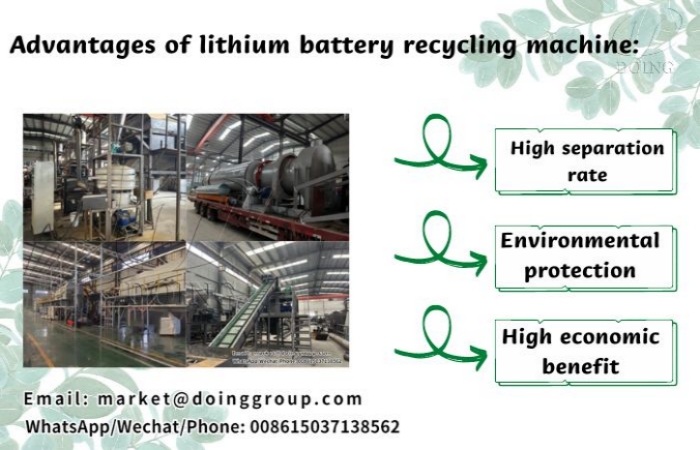 DOING ECO dry mechanical recycling solutions
DOING ECO provides equipment integration, process design, manufacturing, installation, commissioning, and operator training. This allows customers to discuss the entire recycling line with one engineering supplier rather than sourcing every separation machine separately.
If your project needs a complete system, you can provide DOING ECO with your battery types, expected input volume, required capacity, and target output materials. These details allow the engineering team to recommend a more suitable lithium battery recycling equipment configuration and process flow.
Depending on the configuration, the line can process cylindrical, pouch, prismatic, phone, plastic-shell, soft-pack, and power batteries.
No. Batteries need to be discharged before entering the production line. Discharge is a necessary feedstock preparation step, but it is not part of the DOING ECO recycling line.
The main outputs are black mass or black powder, copper, aluminum, iron, and plastic.
The typical capacity range is approximately 500–3,000 kg/h, depending on the battery type, feedstock condition, and line configuration.
Provide the battery types, feedstock condition, expected processing capacity, and desired recovered materials. Photos or videos of the feedstock can also help the manufacturer design the line more accurately.
 Are There Alternatives to Pyrolysis for Recycling Waste Lithium Batteries?
What's Better for End-of-Life Solar Panels: Mechanical Recycling or Pyrolysis?
How to make charcoal briquettes from agricultural waste?
Why Is It Not Recommended To Mix Different Types Of Lithium Batteries Together For Recycling?
Which countries offer policy support for the solar panel recycling business?
How The EU Battery Regulation Impacts Lithium Battery Recycling Startups?