WhatsApp

DOING ECO
Environmental Protection Equipment Manufacturer

Environmental Protection Equipment Manufacturer
As end-of-life photovoltaic (PV) installations continue to grow, recycling companies need efficient equipment to recover valuable materials from discarded solar panels. A fully automatic solar panel recycling machine integrates robotic feeding, panel dismantling, glass removal, crushing, and physical separation to reduce manual handling and improve production efficiency.
DOING ECO provides customaized solar panel recycling equipment for commercial recycling projects. Its upgraded automatic feeding solution uses a robotic arm with visual recognition and suction-cup gripping to handle panels with different sizes and stacking positions. Combined with coordinated processing equipment and PLC-based control, the system supports a more integrated recycling workflow. For businesses seeking a solar panel recycling machine with robotic arm, this configuration offers a practical approach to automating panel feeding.
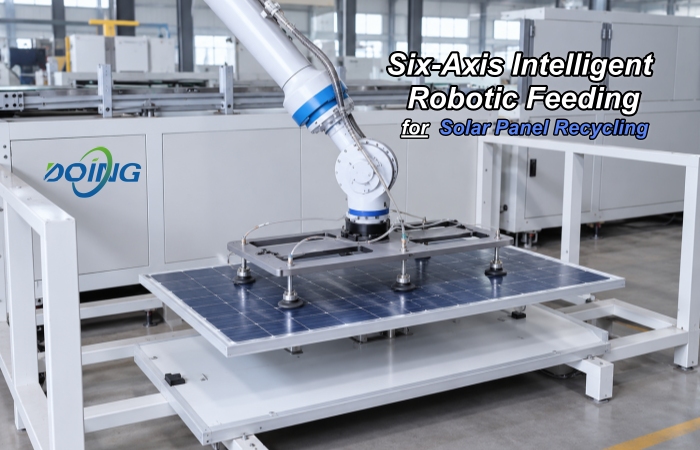 Robotic arm for automatic solar panel feeding
1. Robotic Arm with Visual Recognition for Automatic Feeding
The robotic feeding system is a key feature of DOING ECO's fully automatic solar panel recycling line. Equipped with visual recognition and suction-cup gripping, the robotic arm identifies panel positions and adjusts its gripping movements to handle panels with varying orientations.
According to the equipment configuration described by DOING ECO's technical team, the system can accommodate conventional panels around 1.6 meters and larger modules around 2.1 meters. It is also designed to handle mixed incoming materials, including irregularly stacked and slightly damaged panels, subject to the actual feedstock and system configuration.
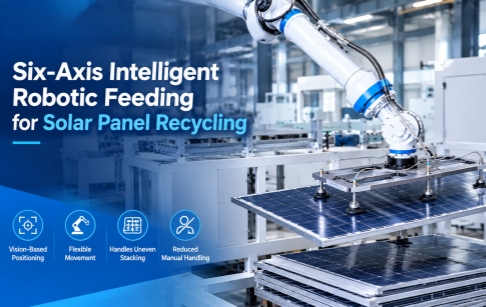
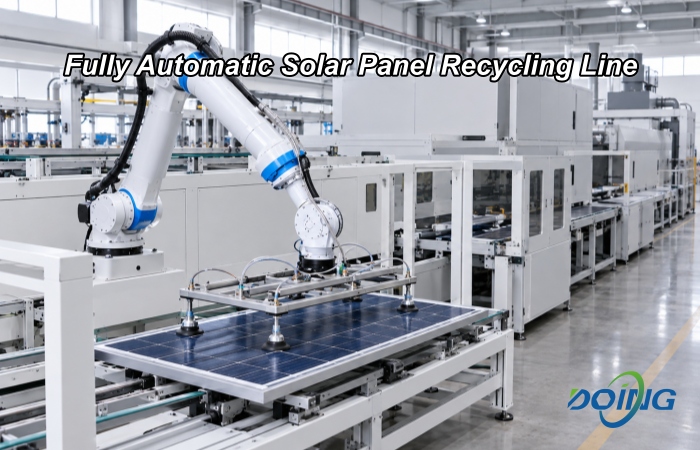 Automated panel handling with robotic feeding
This approach reduces the need to manually arrange every panel before feeding, helping minimize interruptions caused by inconsistent stacking and positioning. It is an important consideration when selecting a fully automatic solar panel recycling machine for projects with varied incoming materials.
2. Multi-Angle Gripping to Reduce Secondary Damage
Solar panels contain fragile glass layers, making handling an important part of the recycling process. The robotic arm can adjust its angle to match the panel surface before the suction cups grip and lift the module.
This multi-angle gripping capability helps the suction cups maintain better contact with panels that are not perfectly aligned, reducing the risk of edge chipping or additional breakage during handling. Actual results depend on panel condition, gripping settings, and operating procedures.
3. Flexible Layout and Integrated Control
Unlike feeding systems restricted to a fixed gantry path, a robotic arm operates within a three-dimensional working envelope. This provides greater flexibility when positioning the feeding station and connecting it with downstream dismantling and separation equipment.
PLC-based control can coordinate compatible processing units and simplify routine operation. The final system layout is designed according to workshop dimensions, panel specifications, processing capacity, and the required degree of automation.
A fully automatic solar panel recycling line combines material handling, mechanical processing, and physical separation. The specific process depends on the panel structure and target recovered materials.
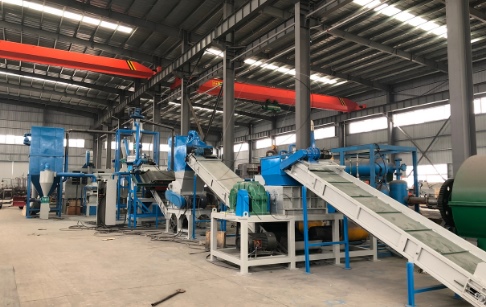
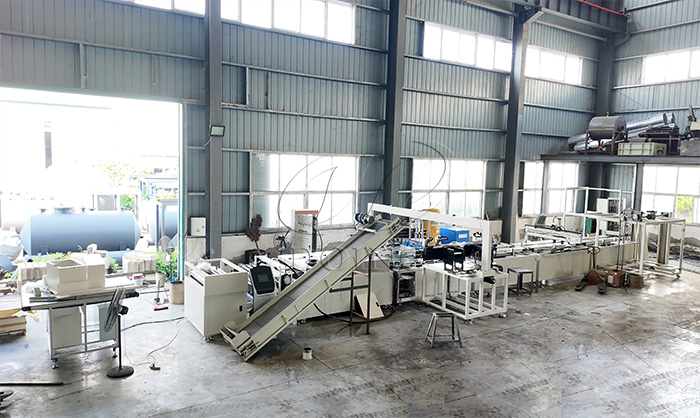 Integrated equipment for PV module recycling
Step 1: Robotic feeding. The robotic arm uses visual recognition and suction-cup gripping to pick up panels and transfer them to the designated feeding position.
Step 2: Frame and junction box removal. Aluminum frames and junction boxes are removed according to the selected dismantling configuration, allowing these components to be collected separately.
Step 3: Glass removal. Suitable single-glass modules undergo mechanical glass separation. Double-glass panels may require a different process configuration, including a pyrolysis tunnel furnace where appropriate.
Step 4: Crushing and material separation. The remaining materials are processed through crushing, screening, gravity separation, electrostatic separation, and other suitable physical separation stages.
Step 5: Material collection and dust control. The separated fractions are collected for further recycling, while pulse dust collection equipment can be integrated to manage dust generated during mechanical processing.
Depending on the configuration, the recovered materials can include aluminum, glass, copper, silicon-containing materials, and plastics.
For project planning, both processing capacity and the level of automation should be evaluated against the incoming panel specifications.
DOING ECO's existing automatic solar panel recycling configuration has a reference processing capacity of approximately 1,000 kg/h, equivalent to around 55–60 panels per hour when the average panel weight is approximately 18 kg. Actual throughput depends on panel weight, feeding conditions, and the final equipment configuration.
DOING ECO's existing solar panel recycling solutions can achieve a material recovery rate of at least 98% and material purity of at least 99% under applicable operating conditions. These figures depend on feedstock composition, process configuration, and the definition of recovery rate and purity.
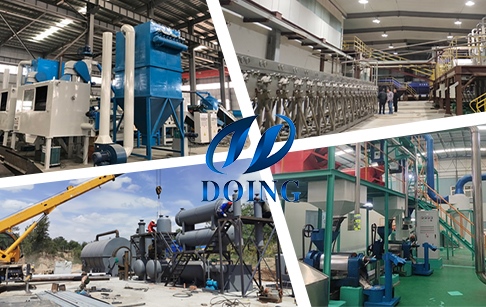
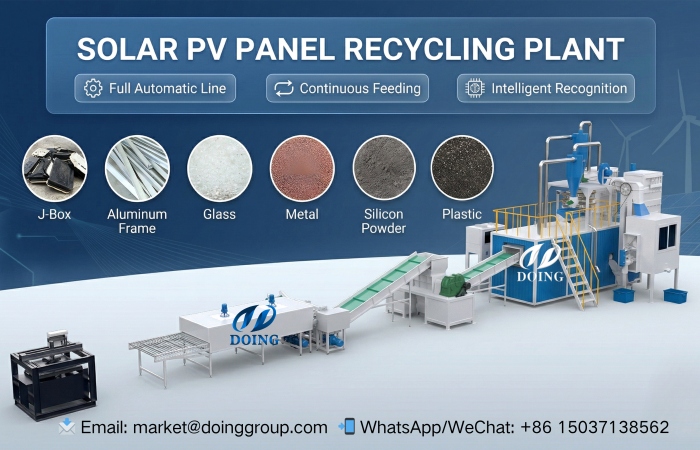 DOING ECO integrated line for solar panel material recovery
For projects requiring a specific output quality or throughput, the equipment configuration should be confirmed against the actual feedstock and production targets.
Reduced manual handling: Robotic feeding reduces repetitive panel loading and the need for manual repositioning at the feeding stage.
Adaptability to mixed feedstock: Visual recognition and adjustable gripping help accommodate different panel positions and sizes within the configured operating range.
Flexible production layout: The robotic arm's three-dimensional working range provides greater freedom when arranging the feeding station and connecting downstream equipment.
Integrated material recovery: Dismantling, glass removal, crushing, and physical separation can be configured as a coordinated production line.
Customized engineering solutions: DOING ECO can tailor equipment selection and layout to panel types, processing capacity, recovered-material requirements, and workshop conditions.
For buyers evaluating a solar panel recycling machine with robotic arm, these features help determine whether the feeding system matches the condition of incoming panels and the operating requirements of the recycling plant.
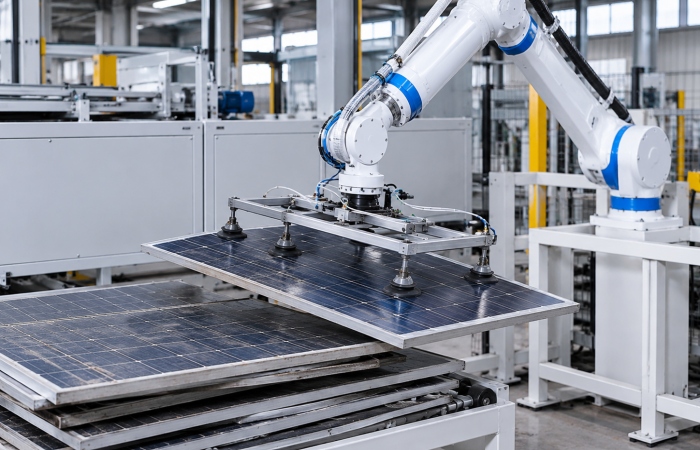 Robotic handling helps reduce manual panel loading
Although robotic feeding reduces manual intervention, the complete recycling plant still requires operators for inspections, maintenance, quality checks, and abnormal-condition handling.
Contact DOING ECO with your panel specifications, estimated processing volume, and target recovered materials to discuss a suitable fully automatic solar panel recycling line for your project.
The visual recognition and suction-cup gripping system is designed to accommodate varying panel positions, including irregular stacking and some slightly damaged modules. Severely broken panels, loose glass, and unusual shapes require a separate assessment to confirm safe and reliable handling.
The equipment can be configured for commercial recycling projects, with a reference processing capacity of approximately 1,000 kg/h for DOING ECO's existing automatic configuration. The appropriate capacity and automation arrangement depend on panel specifications, feeding requirements, and downstream processing conditions.
No. Robotic feeding reduces repetitive manual loading, but operators are still needed for equipment inspection, routine maintenance, quality control, and handling exceptional situations.
DOING ECO offers different recycling configurations for single-glass and double-glass modules. Mechanical glass removal is suitable for applicable single-glass panels, while double-glass modules may require additional or alternative treatment, including a pyrolysis tunnel furnace where appropriate.
 Are There Alternatives to Pyrolysis for Recycling Waste Lithium Batteries?
What's Better for End-of-Life Solar Panels: Mechanical Recycling or Pyrolysis?
How to make charcoal briquettes from agricultural waste?
Why Is It Not Recommended To Mix Different Types Of Lithium Batteries Together For Recycling?
Which countries offer policy support for the solar panel recycling business?
How The EU Battery Regulation Impacts Lithium Battery Recycling Startups?