WhatsApp

DOING ECO
Environmental Protection Equipment Manufacturer
Environmental Protection Equipment Manufacturer
Dry and wet processing are two different approaches to lithium-ion battery recycling. Dry processing relies on mechanical crushing and physical separation to recover black mass, copper, aluminum, and other material fractions. Wet processing uses chemical solutions to extract valuable metals such as lithium, nickel, and cobalt from prepared battery materials.
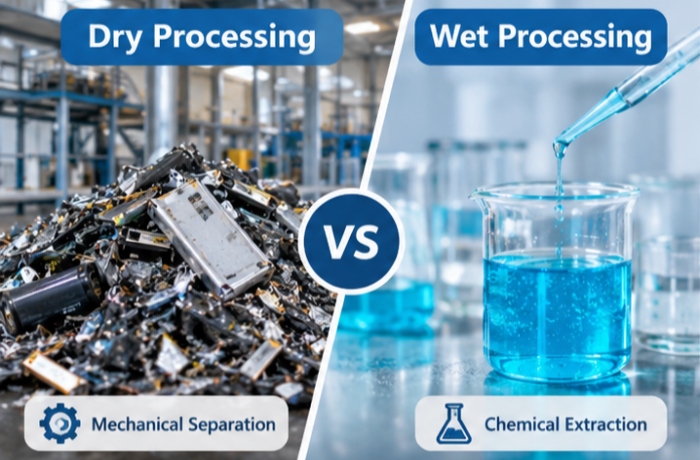 Dry and wet processing in lithium-ion battery recycling
The main difference is their recovery objective: dry processing focuses on material separation and black mass recovery, while wet processing focuses on metal extraction and purification. The two methods can also work together as part of an integrated lithium battery recycling process.
Dry processing uses mechanical equipment and physical separation technologies to recover valuable materials from waste lithium-ion batteries without liquid leaching agents.
A typical dry lithium battery recycling process includes battery discharging, shredding, enclosed drying, secondary crushing, screening, and physical separation. After suitable battery pretreatment and safety control, batteries are shredded and dried to remove residual electrolyte. The dried material then undergoes further crushing, magnetic separation, negative-pressure air separation, and gravity separation to separate different material fractions.
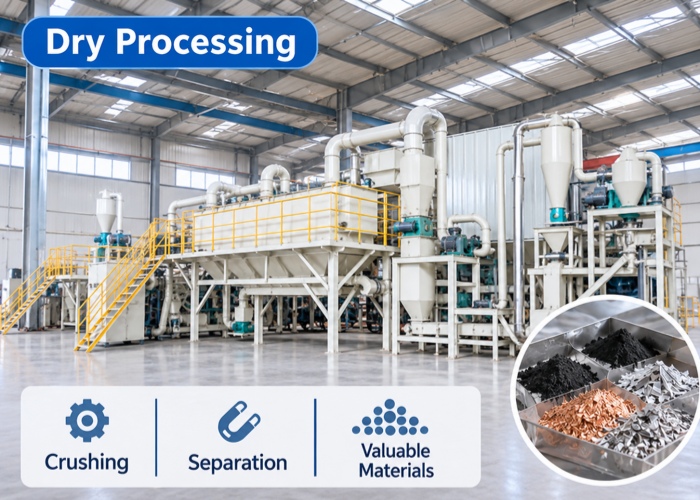 Dry processing lithium battery recycling process
The main recovered products include black mass, copper, aluminum, iron, metal casings, and plastic separator film. Black mass contains valuable cathode and anode materials, including lithium-bearing compounds, nickel, cobalt, manganese, and graphite, depending on battery chemistry. It can be sold to downstream processors or sent to hydrometallurgical facilities for further metal extraction.
The main purpose of dry processing is to separate and concentrate these materials rather than extract individual metals in purified form.
Wet processing in lithium-ion battery recycling generally refers to hydrometallurgy. Unlike dry mechanical processing, it uses chemical solutions to dissolve and recover valuable metals from prepared battery materials, usually black mass.
The main process involves leaching, solid-liquid separation, metal extraction, and purification. During leaching, valuable metals dissolve into a chemical solution. Filtration separates undissolved materials, while processes such as solvent extraction and selective precipitation separate and purify individual metals. The final products may include lithium carbonate, nickel compounds, and cobalt compounds, depending on the battery chemistry and processing route.
Wet hydrometallurgy is suitable for recovering individual valuable metals, but it requires chemical reagents, liquid-processing equipment, and wastewater treatment systems.
The main differences between dry and wet Li-ion battery recycling lie in their recovery objectives, final products, resource requirements, and operating costs.
| Comparison | Dry Processing | Wet Processing |
|---|---|---|
| Main objective | Material separation and black mass recovery | Valuable metal extraction and purification |
| Main products | Black mass, copper, aluminum, iron, and plastic | Lithium, nickel, cobalt, and other metal compounds |
| Water and chemicals | No liquid leaching or chemical leaching reagents | Requires liquid solutions and chemical reagents |
| Operating costs | Mainly equipment, electricity, maintenance, and dust control | Mainly chemical reagents, process equipment, and wastewater treatment |
| Environmental requirements | Dust collection and exhaust gas treatment | Wastewater and chemical residue treatment |
| Typical equipment | Shredders, dryers, crushers, screening machines, magnetic and air separators | Leaching tanks, filtration systems, solvent extraction equipment, precipitation and wastewater treatment systems |
The main cost difference comes from the additional chemical processing and wastewater treatment required by hydrometallurgy. However, actual costs depend on processing capacity, battery chemistry, target products, and local operating conditions.
In simple terms, dry processing separates and concentrates battery materials, while wet processing extracts individual valuable metals. The two methods can complement each other in an integrated lithium-ion battery recycling plant.
The right lithium-ion battery recycling process depends on the plant's target products and business model.
| Recycling Goal | Suitable Processing Method |
|---|---|
| Producing and selling black mass | Dry mechanical processing |
| Separating copper and aluminum | Dry mechanical processing |
| Recovering lithium, nickel, and cobalt compounds | Wet hydrometallurgical processing |
| Building an integrated recycling plant | Dry pretreatment + wet metal recovery |
For recycling businesses focused on black mass production and copper-aluminum separation, dry mechanical processing is a practical choice. For plants targeting purified metal compounds, wet hydrometallurgy is an important downstream process.
Many industrial lithium-ion battery recycling plants combine both methods. Dry processing first separates battery materials and produces black mass, which is then sent to hydrometallurgical facilities for further metal extraction. This approach allows each process to focus on its specific recovery objective.
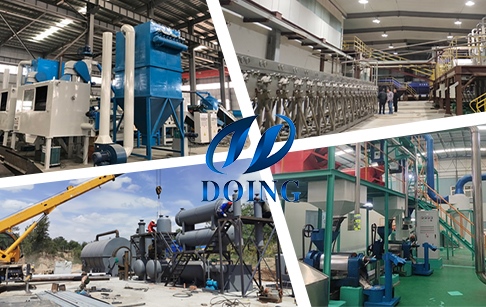
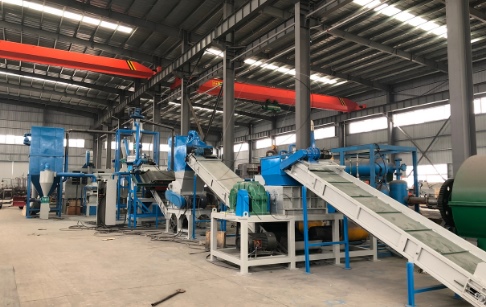
DOING ECO's lithium battery recycling line uses dry mechanical processing to separate valuable materials from waste lithium-ion batteries. The process combines shredding, drying, secondary crushing, screening, and multi-stage physical separation to separate battery active materials from metal components.
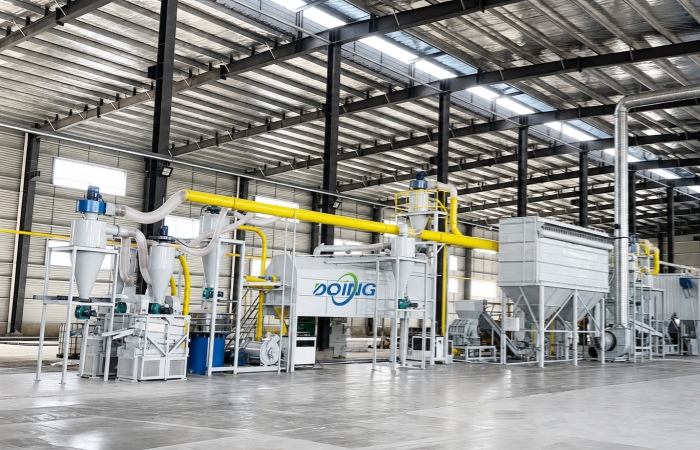 DOING ECO lithium-ion battery recycling line
The recovered materials include black mass, copper, aluminum, iron, metal casings, and plastic separator film. Through staged crushing and separation, the line helps recover black mass while separating different metal fractions for further processing or sale.
Unlike wet hydrometallurgical processing, DOING ECO's dry recycling line focuses on mechanical pretreatment and material separation. It does not directly extract and purify lithium, nickel, or cobalt into individual metal compounds. Instead, the recovered black mass can be supplied to downstream hydrometallurgical facilities for further metal recovery.
For projects involving black mass production and metal separation, DOING ECO can assess a suitable equipment configuration based on battery type, feedstock condition, processing capacity, and target products.
A dry mechanical recycling line may be configured to process both LFP and NMC batteries, depending on the feedstock and equipment configuration. Separate processing batches are recommended to maintain consistent black mass composition and facilitate downstream metal recovery.
Particle liberation is a key factor. If crushing does not sufficiently separate active materials from copper and aluminum foils, metal impurities may remain in the black mass, reducing its quality and recovery value. Crushing and screening settings therefore need to match the incoming battery materials.
Not necessarily. Black mass must meet specific purity and composition requirements before reuse. Further metal extraction, purification, or direct material regeneration may be needed depending on the intended application.
For your lithium battery recycling project, contact DOING ECO with details of your battery type, feedstock condition, processing capacity, and target recovery products to discuss a suitable equipment configuration.
 What Determines Black Mass Quality in Li-Ion Battery Recycling?
What Materials Can Be Recovered from Waste Solar Panels?
What Materials Can Be Recovered from Lithium Battery Recycling?
Is Dry Physical Separation Suitable for Lithium-Ion Battery Recycling?
Are There Alternatives to Pyrolysis for Recycling Waste Lithium Batteries?
What's Better for End-of-Life Solar Panels: Mechanical Recycling or Pyrolysis?